Legitimation And Integration In Developing Societies by Reuven Kahane
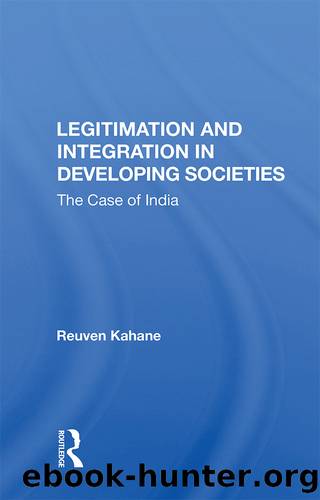
Author:Reuven Kahane [Kahane, Reuven]
Language: eng
Format: epub
Tags: Social Science, General, Sociology
ISBN: 9780429716867
Google: VCqNDwAAQBAJ
Publisher: Routledge
Published: 2019-03-04T03:46:02+00:00
Conclusions
As has been shown, the party system, together with semi- and extra-institutional groups, has reinforced three almost dialectical stages in the process of integration on the political level:
1. In the first stage splits among various primordial groups and/or social classes are accentuated. Each stresses its own identity and establishes its own institutions as instruments of internal solidarity and for the purpose of bargaining with the center and other groups in society.
2. Once these groups achieve solidarity, project a positive and worthy self-image, and are awarded social recognition, they reach the stage of symmetry in their relations with other groups. Since in symmetrical relationships no one group is strong enough to impose its will on others, various groups possessing nearly equal resources reach agreement on general, universal rules.
3. In the final stage, the more or less different but relatively equal groups develop common institutions based on balanced reciprocity and a transcendence of primordial and/or class divisions. These institutions, acting as bargaining arenas, often function in terms of what may be considered a statistical average of the power of the groups involved. Not only has the spectrum of representation been widened through this process but varying interests have also been channelled into the very core of society.
One may characterize political processes in India as a dynamic balance of activities between extra-, quasi-, and intra-institutional movements. It is this dynamism which underlies mediatory processes. Generally speaking, the major phases in the mediation process are: firstly, the use of extreme slogans and extra-institutional tactics, usually prior to election time; and secondly, when advantages are gained or the election won, the establishment of a coalition or alliance between the new ruling parties and some other groups that together attempt to use institutional means (e.g., the legislature) to promote social change. In this context, elections can be defined as mechanisms aimed at the institutionalization of conflict and the allocation of power to different groups. The electoral system mediates between groups by encouraging competition within well-codified boundaries (Bhalla, 1973; Dasgupta and Morris-Jones, 1976:Ch.V).
Indian elections, which have usually increased conflict as well as a sense of separate identity, have also somehow provided an arena for such struggles. This perhaps explains Palmer's findings that seventy-five percent of his sample of Indian voters perceived elections as necessary, and about sixty-six percent felt the same regarding political parties (1975:255-256).
The fact that the Indian party system has been able to keep conflict within institutionalized boundaries may also be explained by a factor which has not been considered until now: its special pattern of organization whereby most parties and political movements are composed of small groups, factions, and caste associations.
Download
This site does not store any files on its server. We only index and link to content provided by other sites. Please contact the content providers to delete copyright contents if any and email us, we'll remove relevant links or contents immediately.
| Anthropology | Archaeology |
| Philosophy | Politics & Government |
| Social Sciences | Sociology |
| Women's Studies |
The Secret History by Donna Tartt(19085)
The Social Justice Warrior Handbook by Lisa De Pasquale(12190)
Thirteen Reasons Why by Jay Asher(8909)
This Is How You Lose Her by Junot Diaz(6885)
Weapons of Math Destruction by Cathy O'Neil(6279)
Zero to One by Peter Thiel(5801)
Beartown by Fredrik Backman(5751)
The Myth of the Strong Leader by Archie Brown(5507)
The Fire Next Time by James Baldwin(5442)
How Democracies Die by Steven Levitsky & Daniel Ziblatt(5218)
Promise Me, Dad by Joe Biden(5153)
Stone's Rules by Roger Stone(5087)
A Higher Loyalty: Truth, Lies, and Leadership by James Comey(4960)
100 Deadly Skills by Clint Emerson(4924)
Rise and Kill First by Ronen Bergman(4788)
Secrecy World by Jake Bernstein(4752)
The David Icke Guide to the Global Conspiracy (and how to end it) by David Icke(4717)
The Farm by Tom Rob Smith(4507)
The Doomsday Machine by Daniel Ellsberg(4490)
